
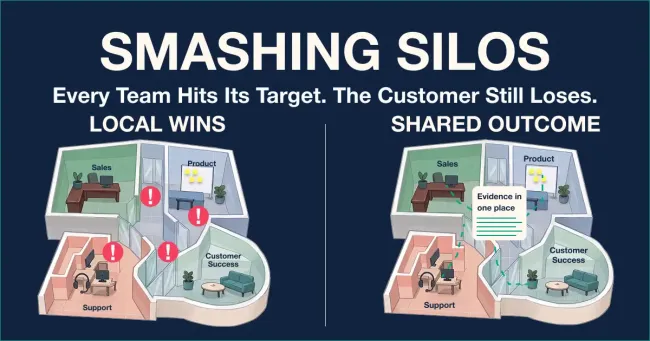
Every department can hit its target and the customer can still have a bad experience. Customers see one company, even when the teams behind that experience are measured separately.
Imagine that Marketing launches a strong campaign with an influencer and a discount code. The campaign performs well, but the customer clicks through and can’t find the product. Or the code doesn’t work because the e-commerce site hasn’t been updated yet. Or maybe the order goes through, but it arrives late or in the wrong size, and the exchange creates another problem. By the end, several teams may have met their own targets, but the customer remembers one frustrating experience and leaves a bad review.
Those experiences carry a price. In a 2025 Qualtrics study of 20,001 consumers in 14 countries, 34% said they reduce their spending with a company after a negative experience, and 13% cut their spending entirely.
That is where silos become a problem. Teams need their own goals, but organizational silos form when several departments shape the same customer outcome but judge success separately. The gaps between them lead to weak handoffs, slower decisions, and friction for customers.
Research on customer experience, goal-setting, and collaboration points to a fix: Connect teams where their work overlaps on the same customer outcome, and leave every other boundary in place.
Key takeaways
- Silos form when teams that share customer outcomes work toward goals and judge success separately.
- Executives and customers often see experiences differently. In a 2025 survey by consulting firm PwC, about nine in 10 executives said customer loyalty had grown, but only four in 10 consumers agreed.
- Shared goals help teams align where their responsibilities overlap without erasing individual roles.
- Warning signs of silos impacting performance include poor handoffs, conflicting metrics, slow decisions, and unclear ownership.
- Customer, operational, and employee feedback can help reveal where teams are disconnected and where action is needed.
Embed code
<center>
<textarea readonly>
<a href="https://www.qualtrics.com/articles/customer-experience/smashing-silos/">
<img src="https://www.qualtrics.com/sites/default/files/styles/standard_3xl_retina/public/2026-11/qualtrics-smashing-silos-v2-2026-11-11-infographic.webp" alt="Smashing Silos: How Shared Goals Unite Disconnected Teams — Infographic" title="Smashing Silos: How Shared Goals Unite Disconnected Teams — Qualtrics — Infographic"></a><br><a href="https://www.qualtrics.com/" alt="Qualtrics Experience Management Software" title="Qualtrics.com">By Qualtrics</a>
</textarea>
</center>
What causes silos, and how do you spot them?
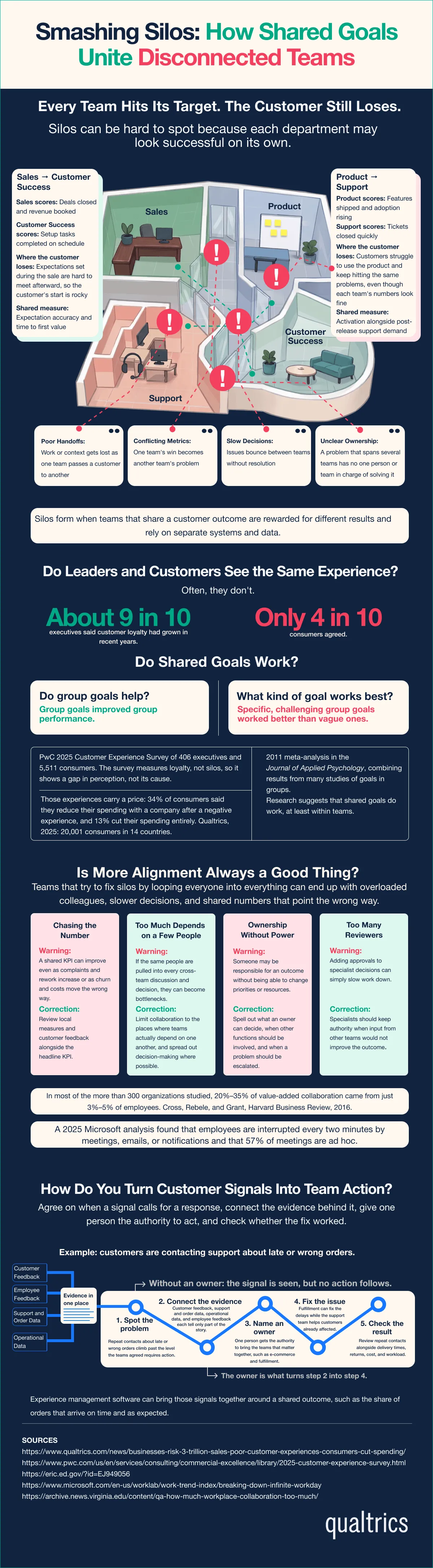
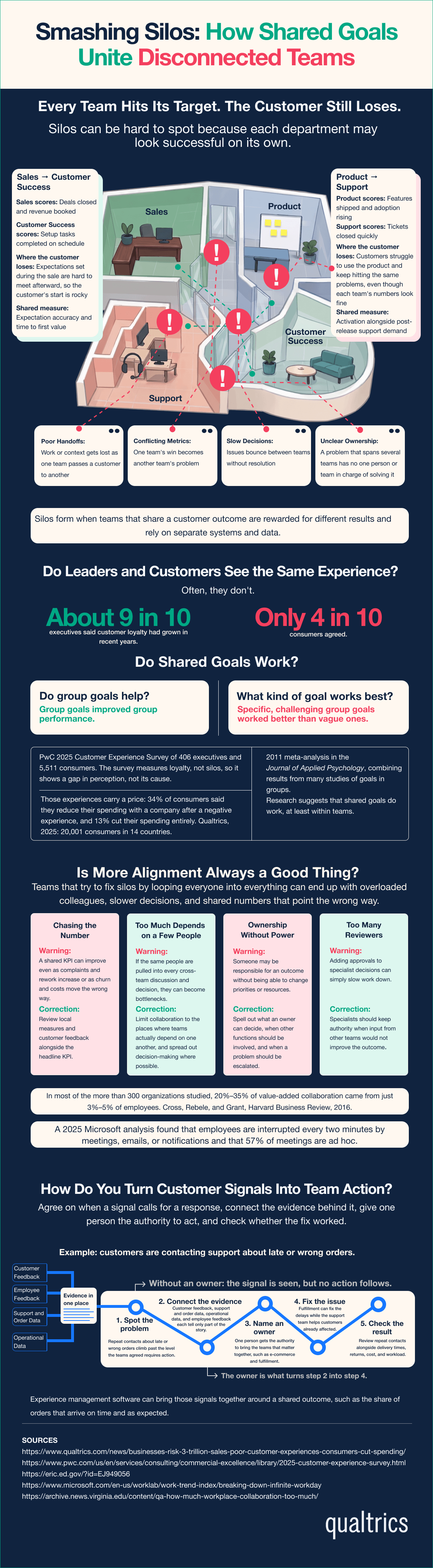
Silos form when teams that share a customer outcome are rewarded for different results and rely on separate systems and data.
Silos can be hard to spot because each department may look successful on its own. Common warning signs include:
- Poor handoffs, where work or context gets lost as one team passes a customer to another
- Conflicting metrics, where one team’s win becomes another team’s problem
- Slow decisions, where issues bounce between teams without resolution
- Unclear ownership, where a problem that spans several teams has no one person or team in charge of solving it
Do leaders and customers see the same experience?
Often, they don’t. In PwC’s 2025 Customer Experience Survey of 406 executives and 5,511 consumers, about nine in 10 executives said customer loyalty had grown in recent years, but only four in 10 consumers agreed.
The survey measures customer loyalty, not silos, so it shows a gap in perception, not its cause. But it does show how far a company’s internal view can drift from what customers experience.
What do shared goals look like, and do they work?
A shared goal gives the teams that influence the same customer outcome one result to be judged on together, while each team keeps its own key performance indicators (KPIs) for the work only it controls.
Here are two examples of how teams can each succeed while the customer still loses, as well as a shared measure they could use to avoid this situation:
|
Teams |
How Each Team Scores its Own Success |
Where the Customer Can Still Lose |
Shared Measure That Connects Them |
|---|---|---|---|
|
Sales and Customer Success |
Sales: Deals closed and revenue booked |
Expectations set during the sale are hard to meet afterward, so the customer’s start is rocky. |
Expectation accuracy and time to first value |
|
Product and Support |
Product: Features shipped and adoption rising |
Customers struggle to use the product and keep hitting the same problems, even though each team’s numbers look fine. |
Activation alongside post-release support demand |
Time to first value is how long a new customer takes to get the first real benefit from a product. It links what customers were promised during the sale to what they experience in the first weeks after signing up, so sales and customer success teams both have a stake in it.
Activation tracks whether new customers complete the early steps that signal that they are getting value from a product.
Research on goal-setting suggests that shared goals do work, at least within teams. A 2011 meta-analysis in the Journal of Applied Psychology combined results from many studies of goals in groups, and it found that group goals improved group performance and that specific, challenging group goals worked better than vague ones.
Is more alignment always a good thing?
Not always, no. Teams that try to fix silos by looping everyone into everything can end up with overloaded colleagues, slower decisions, and shared numbers that point the wrong way.
A shared KPI can become the wrong target
A shared KPI can improve even as complaints and rework increase or as churn and costs move the wrong way. Review local measures and customer feedback alongside the headline KPI, so a good-looking number doesn’t mask a trade-off.
Collaboration can pile up on a few people
Research by Rob Cross, Reb Rebele, and Adam Grant, published in Harvard Business Review in 2016, found that in most of the more than 300 organizations they studied, 20% to 35% of value-added collaboration came from just 3% to 5% of employees. If the same people are pulled into every cross-team discussion and decision, they can become bottlenecks.
A 2025 Microsoft analysis found that employees are interrupted every two minutes by meetings, emails, or notifications and that 57% of meetings are ad hoc. Limit collaboration to the places where teams actually depend on one another, and spread out decision-making where possible.
Ownership and approvals need clear limits
Someone may be responsible for an outcome without being able to change priorities or resources to make that outcome happen. Spell out what an owner can decide, when other functions should be involved, and when a problem should be escalated.
Extra review layers add friction, too. Cross-functional input has value when teams truly depend on each other, but adding approvals to specialist decisions can simply slow work down. Specialists should keep authority when input from other teams would not improve the outcome.
How do you turn customer signals into team action?
To turn customer signals into team action, agree on when a signal calls for a response, connect the evidence behind it, give one person the authority to act, and check whether the fix worked.
Say a growing share of customers are contacting support about late or wrong orders. Here is how that plays out:
- Spot the Problem: Repeat contacts about late or wrong orders climb past the level at which the teams agreed that action is required.
- Connect the Evidence: Customer feedback explains the frustration, support and order data show where it appears, operational data adds context, and employee feedback surfaces handoff or ownership problems the other signals miss. Each one alone tells only part of the story.
- Name an Owner: Give one person the authority to bring the teams that matter together, such as e-commerce and fulfillment.
- Fix the Issue: Fulfillment can fix the delays while the support team helps customers already affected.
- Check the Result: Review repeat contacts alongside delivery times, returns, cost, and workload to see whether the change actually helped.
The owner is what turns step 2 into step 4. Without one, the process can stop at the dashboard: the signal is seen, but no action follows.
The process also depends on seeing the evidence in one place, which is hard when customer, order, and employee data live in separate systems. Customer experience management software can bring those signals together around a shared outcome, such as the share of orders that arrive on time and as expected.
Sources:
- https://www.qualtrics.com/news/businesses-risk-3-trillion-sales-poor-customer-experiences-consumers-cut-spending/
- https://www.pwc.com/us/en/services/consulting/commercial-excellence/library/2025-customer-experience-survey.html
- https://eric.ed.gov/?id=EJ949056
- https://www.microsoft.com/en-us/worklab/work-trend-index/breaking-down-infinite-workday
- https://archive.news.virginia.edu/content/qa-how-much-workplace-collaboration-too-much/