





Diversity programs are usually pitched on values. But the data adds a business argument: Research from two major consulting firms has found that companies with more diverse leadership teams tend to be more profitable and earn more from new products. Meanwhile, a survey of state government employees shows that people planning to leave their jobs rate their workplace culture far lower than people planning to stay. Taken together, the research suggests that who sits at the top and how the workplace treats everyone else are both linked to business results.
Key takeaways
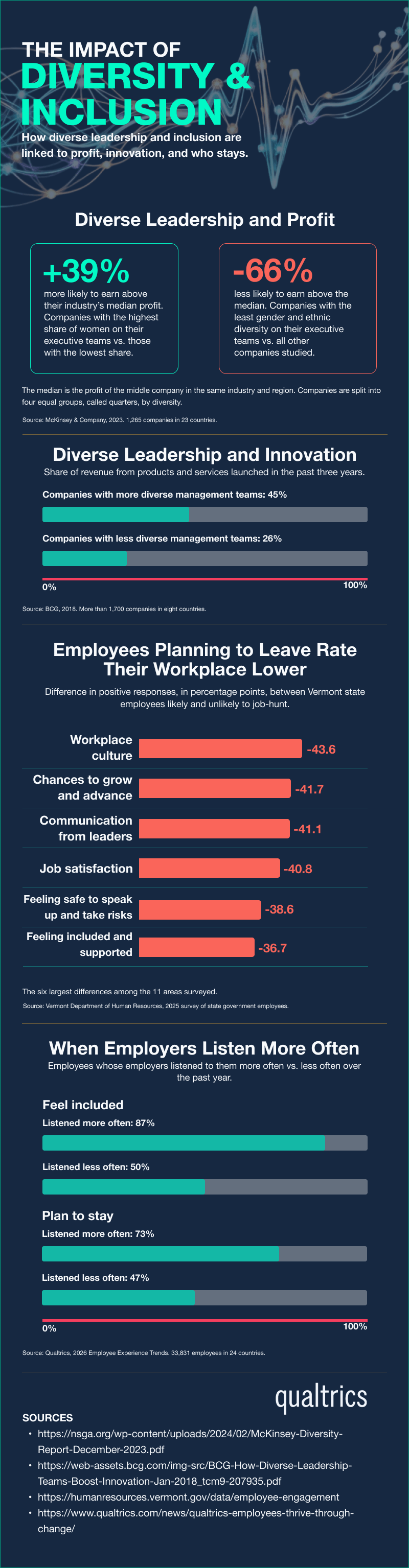
- Companies with the highest share of women on their executive teams (the top quarter of those studied) were 39% more likely to earn above their industry’s median profit than companies with the lowest share (the bottom quarter).
- Companies with the least gender and ethnic diversity on their executive teams (the bottom quarter on both measures) were 66% less likely to beat the median for profit in their industry than the other companies studied.
- Companies with more diverse management teams earned 45% of their revenue from products and services launched in the past three years, versus 26% for less diverse companies.
- Among Vermont state employees, those likely to job-hunt were far less likely than those planning to stay to agree with positive statements about their workplace culture: 38% vs. 81%.
- Employees whose employers had listened to them more often over the past year were much more likely to say they feel included in the workplace: 87% vs. 50%.
Embed code
<center>
<textarea readonly>
<a href="https://www.qualtrics.com/articles/employee-experience/dei-impact/">
<img src="https://www.qualtrics.com/sites/default/files/styles/standard_xl_retina/public/2026-11/qualtrics-dei-business-impact-infographic.webp" alt="The Business Impact of Diversity and Inclusion— Infographic" title="The Business Impact of Diversity and Inclusion — Qualtrics— Infographic"></a><br><a href="https://www.qualtrics.com/" alt="Qualtrics Experience Management Platform" title="Qualtrics.com">By Qualtrics</a>
</textarea>
</center>
Do more diverse companies perform better?
Research links more diverse leadership teams to higher profits, though it shows a pattern, not proof of cause.
Diversity Matters Even More, a report from McKinsey & Company, a global management consulting firm, looked at 1,265 companies in 23 countries. The researchers ranked the companies by the share of women on their executive teams and put them into four groups. They then compared how likely each group was to beat the median profit of companies in the same industry and region.
The quarter of companies with the highest share of women on their executive teams was 39% more likely to beat the median than the quarter with the lowest share. Ranking companies by ethnic diversity instead of gender produces the same 39% gap between the highest and lowest quarters. Boards of directors show a similar pattern: 27% for gender and 13% for ethnicity.
McKinsey’s research also found that companies in the lowest quarter for both gender and ethnic diversity were 66% less likely to beat the median than all the other companies in the study. McKinsey says the 66% figure, up from 27% in 2020, suggests that a lack of diversity may be getting more costly.
The benefit has limits. Companies in the highest quarter on both gender and ethnic diversity were on average 9% more likely to beat the median, and McKinsey notes that this gap has narrowed slightly since its last report.
Representation still has a long way to go. About one in five executives in McKinsey’s dataset is a woman. And among companies in both its 2020 and 2023 reports, only 16% of executives belong to historically underrepresented ethnic groups. In the U.S., those groups make up 41% of the population but hold about 20% of executive roles at the companies studied.
Does diversity help companies innovate?
Companies with more diverse management teams report earning a much larger share of revenue from new products (45% vs. 26%), suggesting a connection between diversity and innovation.
Boston Consulting Group (BCG), another global consulting firm, surveyed employees at more than 1,700 companies in eight countries. It measured innovation by the share of revenue coming from products and services launched in the past three years. Companies with above-average diversity on their management teams earned 45% of revenue from new offerings; companies with below-average diversity earned 26%. The more diverse companies also had operating profit margins 9 percentage points higher than the less diverse companies.
BCG’s research also found that companies with equal pay, leaders who invite different viewpoints, and open communication reported nearly 13 percentage points more revenue from new products than companies where those practices were weak or missing. BCG’s study dates to 2018, however, so it works best as a foundational finding rather than a current benchmark.
Whatever the exact size of the effect, a diverse team only helps if people stay and can contribute. That depends on how the workplace feels to them.
Does feeling included at work affect whether employees stay?
Data suggests that employees who feel less included are more likely to be planning to leave.
A 2025 survey of employees in the executive branch of Vermont’s state government asked them to rate their workplace, then compared responses between employees planning to leave their jobs and those planning to stay. About 18% of employees said they were likely to look for a new job in the next year, and nearly 60% said they were unlikely to.
The survey asked how much employees agreed with positive statements about 11 areas of their workplace. Here are the top six areas where the two groups differed most:
|
What Employees Rated |
Positive Responses From Those Unlikely to Job-Hunt |
Positive Responses From Those Likely to Job-Hunt |
Difference in Percentage Points |
|---|---|---|---|
|
Workplace culture |
81.4% |
37.9% |
-43.6 |
|
Chances to grow and advance |
73.9% |
32.2% |
-41.7 |
|
Communication from leaders |
77.6% |
36.5% |
-41.1 |
|
Job satisfaction |
90.8% |
50.0% |
-40.8 |
|
Feeling safe to speak up and take risks |
78.1% |
39.5% |
-38.6 |
|
Feeling included and supported |
82.2% |
45.4% |
-36.7 |
The report’s authors caution that this shows relationships, not causes: Employees who plan to leave may rate their workplace lower because they are already on their way out.
However, a 2026 Qualtrics survey of 33,831 employees in 24 countries points the same way. Among employees whose employers had listened to them less often over the past year, 50% said they feel included and 47% planned to stay in their jobs. Among those whose employers had listened more often, the figures were 87% and 73%, respectively.
Taken together, these surveys suggest that inclusion can be measured and that people tend to feel more included when their employers listen to them more often.
How can organizations measure diversity and inclusion?
Organizations can measure diversity and inclusion by tracking the same things these studies tracked and reading the results together, since no single number tells the whole story.
- Who Leads: The share of executives and board members by gender and ethnicity, compared with your workforce and region. McKinsey’s profit findings rest on this measure.
- Pay Fairness: Pay for people in similar roles, compared across groups. BCG found more revenue from new products at companies with practices like equal pay.
- How Included People Feel: Ask employees directly whether they belong and have a fair chance to succeed. Both Vermont and Qualtrics measured this.
- Whether Feedback Leads to Change: Ask for feedback regularly and share what changed as a result. Qualtrics found much higher inclusion and intent to stay where employers listened more often.
Frequently asked questions
What is the difference between diversity and inclusion?
Diversity is about who is in an organization, such as the mix of genders, ethnicities, ages, and backgrounds, while inclusion is about how people experience the organization once they are there, including whether they feel they belong and can contribute.
The Vermont survey, for example, measured inclusion by asking whether employees see diversity valued at all levels, whether leaders meet everyone’s needs, whether supervisors would act on bias or harassment, and whether employees can succeed as their authentic selves.
McKinsey notes that representation alone is not enough and that diverse teams do best in cultures that foster inclusion and belonging.
Why would a more diverse leadership team perform better?
Researchers have ideas about why diverse leadership teams perform better but haven’t proven a definitive cause.
BCG’s explanation, for instance, is that people with different backgrounds and experiences often see the same problem in different ways, which produces more possible solutions and raises the odds that one succeeds.
Is diversity only about gender and race?
No: Diversity can come in many forms, including age, nationality, or education level.
McKinsey’s analysis looks at gender and ethnicity, but BCG measured six dimensions of management diversity: gender, age, national origin, career path, industry background, and education. All six were linked to more revenue from new products, with the biggest gains tied to national origin, industry background, gender, and career path. Age and education showed smaller effects.
How can a company help employees feel included?
McKinsey interviewed leaders at companies known for diversity and identified five strategies to help employees feel included:
- Commit to a purpose-led approach that benefits everyone with a stake in the company.
- Build it into company-wide business initiatives while letting local teams adapt it.
- Prioritize belonging and inclusive practices, such as management training, accountability for inclusive leadership, and support for employee groups built around shared backgrounds or interests.
- Recognize and support the leaders and allies who do this work.
- Act on employee feedback, including disagreement.
Listening also stood out in the Qualtrics data. Employees whose employers had listened to them more often were more likely to say they feel included (87% vs. 50%).
Sources:
- https://nsga.org/wp-content/uploads/2024/02/McKinsey-Diversity-Report-December-2023.pdf
- https://web-assets.bcg.com/img-src/BCG-How-Diverse-Leadership-Teams-Boost-Innovation-Jan-2018_tcm9-207935.pdf
- https://humanresources.vermont.gov/data/employee-engagement
- https://www.qualtrics.com/news/qualtrics-employees-thrive-through-change/


